Jump to heading 9.Positional Relationships Between Two Lines

Positional RelationshipSlope-Intercept Form
l1:y=k1x+b1
l2:y=k2x+b2
General Form
l1:a1x+b1y+c1=0
l2:a2x+b2y+c2=0
Parallell1∥l2⇔k1=k2,b1≠b2l1∥l2⇔a1a2=b1b2≠c1c2
Intersectingk1≠k2a1a2≠b1b2
Perpendicularl1⊥l2⇔k1k2=−1l1⊥l2⇔a1b1⋅a2b2=−1⇔a1a2+b1b2=0

Examples

  • Slope-Intercept Form
    • Parallel
      y=2x−1y=2x+3k→2=2b→−1≠3Not coincident
    • Perpendicular
      y=−12x−1y=2x+3k1k2=−1→(−12)×2=−1
  • General Form
    • Parallel
      2x−3y+1=04x−6y+5=0a1a2=b1b2→24=−3−6b1b2≠c1c2→0.5≠15Not coincident
    • Perpendicular
      3x+4y−1=04x−3y+2=0a1a2+b1b2=0→3×4+(4×−3)=0

Jump to heading 10.Focus 4

Two lines are parallel

  • Analyze parallelism based on equal slopes, paying attention to the cases where the slope is 0 or undefined.

Jump to heading 12Given that the line l1:(k−3)x+(4−k)y+1=0 is parallel to the line l2:2(k−3)x−2y+3=0, what is the value of k?.

(A)3(B)5(C)1(D)−1(E)3∨5

Jump to heading Solution

  • Substitute the options to verify the equation

    a1a2=b1b2≠c1c2k−32(k−3)=4−k−2≠13Pay attention to the special case where k=3k=3{l1:y+1=0Horizontal line a=0l2:−2y+3=0Horizontal line a=0k=3⟶l1 and l2 are parallel12=4−k−2≠13Substitute k=512=4−5−212=12≠13

Jump to heading Conclusion

  • Derived Solution

    (E)
    According to the Solution, get k=3,k=5l1 and l2 are parallel, so choose E.

  • Formula used

    l1∥l2⇔a1a2=b1b2≠c1c2Parallel positional relationshipa=0⟶by+c=0Horizontal line


Jump to heading 11.Focus 5

Two lines are perpendicular

  • When the product of the slopes of two lines is -1, or when their slopes are negative reciprocals of each other, the two lines are perpendicular. Note the special cases when the slope is 0 or undefined.

Jump to heading 13(Sufficiency judgment) Determine whether the condition that the lines (m+2)x+3my+1=0 and (m−2)x+(m+2)y−3=0 are perpendicular is sufficient.

(1)m=12.(2)m=−2.(A)(1)(B)(2)(C)(1)+(2)(D)(1),(2)(E)∅

Jump to heading Solution

a1a2+b1b2=0(m+2)(m−2)+3m(m+2)=0Verify condition (1)(12+2)(12−2)+312(12+2)=0(52×−(32))+(3×54)=0−154+154=0Verify condition (2)(−2+2)(−2−2)+3(−2)(−2+2)=0(0×(−4))+(−6×0)=00+0=0

Jump to heading Conclusion

  • Derived Solution

    (D)
    According to the Solution, get (1)✅,(2)✅, so choose D.

  • Formula used

    a1a2+b1b2=0Perpendicular positional relationship


Jump to heading 14If the line mx+3y+5=0 is perpendicular to the line nx−2y+1=0, how many sets of positive integer solutions (m,n) satisfy this condition ?.

(A)1(B)2(C)3(D)4(E)5

Jump to heading Solution

a1a2+b1b2=0mn+3×(−2)=0mn=66=1×66=6×16=2×36=3×2

Jump to heading Conclusion

  • Derived Solution

    (D)
    According to the Solution, get 4 sets, so choose D.

  • Formula used

    a1a2+b1b2=0Perpendicular positional relationship


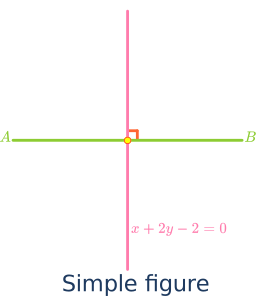
Jump to heading 15Given point A(1,−2) and point B(m,2), and the equation of the perpendicular bisector of line segment AB is x+2y−2=0, what is the value of the real number m?.

(A)3(B)4(C)5(D)6(E)7

Jump to heading Solution

  • 1Solve by setting up equations

    (m+12,0)Midpointm+12+0−2=0m+1+0−2=2m+1=4m=3

  • 2Solve using slopes

    kAB=2−(−2)m−1k=−abx+2y−2=0⟶k=−12The slope of AB and the slope of the line x+2y−2=0are negative reciprocals of each other, since AB is perpendicular to x+2y−2=0.kAB⇒21kAB=4m−1=24=2m−262=mm=3

Jump to heading Conclusion

  • Derived Solution

    (A)
    According to the Solution, get m=3, so choose A.

  • Formula used

    (x1+x22,y1+y22)Midpoint formulak=y2−y1x2−x1Two-point slope formulak=−abQuickly convert the general form to the slope


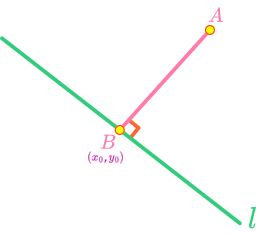
Jump to heading 16Given that the equation of line l is x+2y−4=0, and point A has coordinates (5,7), a line is drawn through point A perpendicular to line l. What is the x-coordinate of the foot of the perpendicular ?.

(A)6(B)5(C)2(D)−2(E)−1

Jump to heading Solution

  • Show known conditions

    k=−abl=x+2y−4=0⟶k=−12

  • 1Solve by using the two-point slope formula to write a system of equations and find the point of intersection

    Let B=(x0,y0)k:l=−12⟶AB=21=2{x0+2y0−4=0Point B on line ly0−7x0−5=2The inclination from A to Bx0+2y0−4=0Simplify equation 1x0=4−2y0y0−7x0−5=2Simplify equation 2y0−7=2(x0−5)y0−7=2x0−10y0=2x0−3y0=2(4−2y0)−3Substitute x0y0=8−4y0−3y0=5−4y05y0=5y0=1x0=4−2×1Substitute y0x0=2

  • 2Solve by using the point-slope form to write a system of equations and find the point of intersection

    k:l=−12⟶AB=21=2y=2(x−5)+7=2x−3The equation of the line AB{x+2y−4=0y=2x−3x+2(2x−3)−4=0Substitute yx+4x−6−4=05x−10=05x=10x=2

Jump to heading Conclusion

  • Derived Solution

    (C)
    According to the Solution, get x=2, so choose C.

  • Formula used

    k=y2−y1x2−x1Two-point slope formulak=−abQuickly convert the general form to the slopey=y0+k(x−x0)Point-slope form


Jump to heading 12.Focus 6

Two lines intersect

  • When the slopes of two lines aren't equal, the lines intersect. Additionally, you should know how to find the coordinates of the intersection point.
  • Intersection point = Solve the system of equations formed by the two lines.

Jump to heading 17(Sufficiency judgment) Determine whether the condition that the lines (m+1)x+3y+1=0 and 2x+my−3=0 intersect is sufficient.

(1)m>12.(2)m<−4.(A)(1)(B)(2)(C)(1)+(2)(D)(1),(2)(E)∅

Jump to heading Solution

a1a2≠b1b2Intersect→Not proportionalm+12≠3mm2+m−6≠0m2+m−6⇒(m−2)(m+3)=0m=2∨m=−3⟶m≠2∧m≠−3m∈R∖{2,−3}Verify condition (1)m>12⇒m=2Verify condition (2)m<−4⇒m≠2∧m≠−3

Jump to heading Conclusion

  • Derived Solution

    (B)
    According to the Solution, get m<−4⇒m≠2∧m≠−3, so choose B.

  • Formula used

    a1a2≠b1b2Intersecting positional relationship


Jump to heading 18What is the distance from the intersection point of the lines 2x+3y+4=0 and 3x+y−1=0 to the origin ?.

(A)2(B)3(C)2(D)5(E)7

Jump to heading Solution

{2x+3y+4=03x+y−1=0⟶9x+3y−3=0(9x+3y−3)−(2x+3y+4)=0−07x−7=0x=13×1+y−1=0Substitute xy=−2The distance from (1,−2) to the origin.d=(1−0)2+(−2−0)2=5

Jump to heading Conclusion

  • Derived Solution

    (D)
    According to the Solution, get d=5, so choose D.

  • Formula used

    d=(x2−x1)2+(y2−y1)2Two-point distance formula


Jump to heading 13.Positional Relationship Between a Point and a Line

  • For a point (x0,y0) and a line l:y=kx+b

    y0{>kx0+b, the point lies above the line.=kx0+b, the point lies on the line.<kx0+b, the point lies below the line.

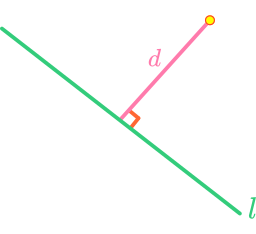
Jump to heading 14.Distance from a Point to a Line

  • For the line l:ax+by+c=0, the distance from the point (x0,y0) to the line is d=|ax0+by0+c|a2+b2.
  • Special case: The distance from (0,0) to the line l is d=|c|a2+b2.

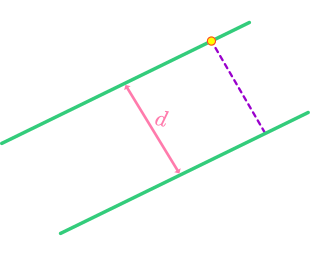
Jump to heading 15.Distance Between Two Parallel Lines

  • Given two parallel lines: l1:ax+by+c1=0; l2:ax+by+c2=0. The distance between l1 and l2 is d=|c1−c2|a2+b2.
  • Remark: The derivation process involves selecting an arbitrary point on one of the lines and then using the formula for the distance from a point to a line to calculate the distance between the two parallel lines.

Jump to heading 16.Focus 7

Positional Relationship Between a Point and a Line

  • First, convert the line into the form y=kx+b, then substitute the point into the equation to make a determination.
  • Note: Make sure the coefficient of y is positive; otherwise, the result of the judgment will be reversed.
  • General form: ax+by+c=0

    b>0{ax+by+c>0The point is above the line.ax+by+c<0The point is below the line.b<0{ax+by+c>0The point is below the line.ax+by+c<0The point is above the line.

Jump to heading 19Given the equation of line l:x+2y−4=0, and the coordinates of point A are (5−m,m). If point A is above the line l, what is the range of values for m?.

(A)m>1(B)m>−1(C)m>−2(D)m>−12(E)m<−1

Jump to heading Solution

A:(5−m,m)5−m+2m−4>0(5−4)+(−m+2m)>01+m>0m>−1

Jump to heading Conclusion

  • Derived Solution

    (B)
    According to the Solution, get m>−1, so choose B.

  • Formula used

    y=kx+bPoint-line position


Jump to heading 17.Focus 8

Distance from a Point to a Line

  • First, convert the line equation into general form, then apply the point-to-line distance formula.

Jump to heading 20Given point C(2,−3), and points M(5,5),N(−3,−1), what is the distance from point C to the line MN?.

(A)235(B)225(C)215(D)195(E)185

Jump to heading Solution

KMN=5−(−1)5−(−3)=68=343x−4y+c=0Reverse-derive the general formula for k=−ab3×5−4×5+c=0Substitute M∨N15−20+c=0c=53x−4y+5=03×2−4×(−3)+5=0Substitute Cd=|ax0+by0+c|a2+b2d=6+12+532+42=235

Jump to heading Conclusion

  • Derived Solution

    (A)
    According to the Solution, get d=235, so choose A.

  • Formula used

    k=y2−y1x2−x1Two-point slope formulak=−abQuickly convert the general form to the slopeax+by+c=0General form of a lined=|ax0+by0+c|a2+b2Point-to-line distance formula


Jump to heading 18.Focus 9

Distance Between Two Parallel Lines

  • To apply the distance formula between two parallel lines, make sure to first unify the coefficients of x and y in both equations, and then proceed with the calculation.

Jump to heading 21Given l1:3x−4y+2=0,l2:6x−8y+9=0, What is the distance between l1 and l2?.

(A)710(B)14(C)13(D)12(E)75

Jump to heading Solution

  • Unify the x and y coefficients of the two parallel lines before solving

    l1:3x−4y+2=0→6x−8y+4=0Multiply both sides by 2l2:6x−8y+9=0d=|c1−c2|a2+b2d=|9−4|62+82=510=12

Jump to heading Conclusion

  • Derived Solution

    (D)
    According to the Solution, get d=12, so choose D.

  • Formula used

    d=|c1−c2|a2+b2Parallel Lines Distance Formula


PlatformsCoursesCoursewares
YouTubeWatchCourseware
DailymotionWatch
RumbleWatch